First, let’s set the standard. Always follow your artist’s instructions. That is not a throwaway line. It matters because there is no single universal tattoo-aftercare gold standard, and dressing type alone can change when lotion should begin. A tattoo healing under a second-skin film is not managed the same way as a tattoo healing with a traditional wash-and-moisturise routine. Good aftercare is not about copying the internet word for word. It is about understanding the stage you are in and keeping the skin balanced.
f you want the direct answer, here it is. Most new tattoos do best with a thin layer of fragrance-free lotion or an artist-approved aftercare emollient around 2 to 3 times a day once the lotion stage begins. Not five thick coats. Not one heavy layer that sits on the surface all day. Just enough to stop the tattoo from getting tight, chalky, or cracked. The skin should look lightly hydrated, not wet or shiny. If you are still wearing an intact second-skin dressing, do inte lotion underneath it. Wait until that dressing is removed and the area has been gently washed and dried.
This guide is educational, not a medical diagnosis. If the tattoo becomes increasingly red, hot, swollen, unusually painful, starts leaking pus, or you feel unwell or feverish, get medical advice promptly. Serious infections and allergic reactions do happen, even though normal healing can involve mild redness, flaking, and itch.
Why the timing is not the same for everyone
A fresh tattoo is a controlled skin injury. Placement, tattoo size, climate, friction from clothing, how much plasma the area produces, and whether your artist uses film or a more traditional wrap all influence how quickly the tattoo moves from “open wound” to “light moisturising” territory. That is one reason public aftercare advice varies so much. Dermatology researchers who reviewed 700 tattoo-aftercare instructions found major inconsistency in what people are told to do.
The goal is not to keep the tattoo dry. It is also not to keep it wet. The goal is a calm, clean, lightly supported healing environment. Wound-healing literature supports a moist healing environment, while postprocedure dermatology reviews show that breathable, semi-occlusive formulations can help with re-epithelialization and barrier recovery. In plain English, that means the tattoo should feel comfortable and flexible, not crusted over and not smothered.
Tattoo lotion timeline
The timeline below reflects the safest broad pattern for general readers. Your artist may adjust it depending on the wrap they used and how your skin behaves.
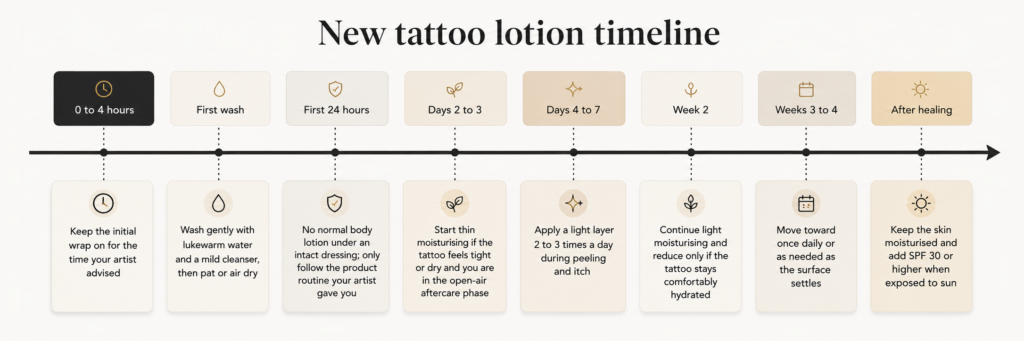
That flow is consistent with the strongest available aftercare principles: film dressings may stay in place for 24 hours to several days, early-stage ointment/emollient routines are typically light rather than heavy, and sunscreen becomes important after healing is complete.
The first 24 hours
This is the stage where people make the most avoidable mistakes. If your tattoo is still under a film or second-skin type dressing, leave it alone unless your artist told you otherwise or the seal is failing. Do not keep lifting the edge to “check on it.” Do not put lotion over or under the dressing. If you are on a more traditional wrap routine, remove the wrap when instructed, wash gently, pat dry, and follow the specific aftercare product guidance you were given. The point here is hygiene first, not over-handling.
A lot of confusion comes from the word lotion. Some artists use a healing ointment or aftercare balm first and switch to lotion later. Others move to a light fragrance-free lotion earlier. Do not get stuck on the label. Focus on whether the product is appropriate for healing skin, artist-approved, lightly applied, and not heavily fragranced or needlessly occlusive.
Days 2 to 7
For most people, this is when the real question starts. The tattoo begins to feel tight, dry, or itchy. Peeling may start. This is usually the point where a new tattoo benefits from light, consistent moisturising. In practical terms, that usually means a thin layer 2 to 3 times a day, often after washing in the morning and evening, plus one small reapplication later if the tattoo feels dry. If the area still looks shiny from the last application, leave it alone. It does not need more just because it is “time.”
This is also the phase where over-moisturizing causes problems. If you keep the tattoo greasy all day, you can soften the forming scabs too much, trap heat and moisture, and create a messy healing environment. If you use too little, the area can become so dry that flakes crack and the itch gets worse. The correct look is simple: the tattoo should be comfortable and lightly hydrated, not glossy and not brittle.
Weeks 2 to 4
By this point, the tattoo often looks calmer than it really is. The surface may seem nearly healed while the deeper barrier is still settling. This is where people either stop too early or keep applying too much because they are nervous. Usually, the routine can begin tapering here. Many tattoos move from 2 to 3 light applications a day down to once daily or as needed, depending on dryness, friction, and climate. If the tattoo feels normal and no longer gets tight between applications, reduce rather than forcing the earlier schedule.
Once the tattoo is fully healed, basic skin care takes over. Healthy skin makes healed tattoos look better. Daily moisturising helps with dryness and itch, and sun protection matters for keeping the tattoo looking sharp over time. If you want the long-term side of that conversation,
What kind of lotion should you use
Keep this part simple. The safest general choice is a fragrance-free, unperfumed, alcohol-free lotion or aftercare emollient that your artist is comfortable with and your skin tolerates well. AAD specifically recommends a water-based lotion or cream when tattooed skin feels dry, and EADV advises hypoallergenic / unperfumed emollient care. There is also real evidence that fragranced products can backfire: a published case report linked a scented lotion to allergic contact dermatitis, scarring, and premature fading in a new tattoo.
Products containing panthenol or dexpanthenol can be reasonable options because the dermatology literature supports their role in moisturising, barrier support, and superficial wound recovery. That does not mean one brand is mandatory. It means ingredients that support barrier repair make more sense than random perfumed body lotion from the back of a bathroom cabinet.
What should you avoid? In general, avoid strong fragrance, harsh alcohol-heavy formulas, unnecessary antibiotic creams, and any product that leaves the tattoo sitting under a thick, greasy coat. Antibiotic creams are not part of standard normal healing according to EADV and should be used only when infection has actually been medically assessed.
Signs you are using too much or too little
f you are overdoing it, the tattoo may stay shiny for hours, feel tacky, develop small clogged bumps, or look as though the skin is staying too soft and wet. If you are underdoing it, the tattoo may feel tight, itchy, and dry enough that the flakes crack rather than lift off naturally. The right routine is usually boring. That is a good sign. The tattoo is clean, calm, lightly moisturised, and not demanding constant intervention.
A useful rule is this: reapply because the tattoo needs it, not because the clock says you should. During the main healing window, 2 to 3 light applications a day is a good baseline. But if your tattoo still looks comfortably hydrated, skip the extra layer. If it is dry and tight, add a light one. That small bit of judgment is better than blindly following a rigid number.
Gratis på iOS och AndroidApp för tatueringsläkare
Slipp gissningsleken ur din återhämtning! De första dagarna av läkning är de mest kritiska. För att hjälpa dig navigera denna period med fullständig tillförsikt har vi utvecklat Tattoo Healer-appen, din digitala eftervårdsguide.
Common mistakes that slow tattoo healing
The first mistake is starting with the wrong timing. If you are under a second-skin style bandage, lotion does not go under it. If you are in an open-air routine, do not wait until the tattoo becomes severely dry and crack-prone before applying anything. Both extremes create unnecessary problems.
The second mistake is using too much product. A tattoo does not heal better because it is coated all day. A semi-occlusive, breathable environment is useful. Smothering the area is not. If the tattoo looks wet, sticky, or heavily glazed, pull back.
The third mistake is reaching for whatever body lotion happens to be nearby. Scented products are a bad gamble on healing skin, and case evidence shows they can do real damage. This is one of the easiest problems to avoid. Use something simple and fragrance-free.
The fourth mistake is forgetting that lotion is only one part of tattoo aftercare. Clean hands still matter. Gentle washing still matters. Avoiding pools, baths, and unnecessary friction still matters. Lotion cannot save a routine that is careless everywhere else.
Quick tattoo lotion checklist
If you want the short version, this is what matters most:
- Follow your artist’s exact instructions first
- Do not lotion under an intact second-skin dressing
- Use a thin layer, not a visible heavy coat
- Choose fragrance-free, alcohol-free, healing-appropriate products
- During the main healing phase, start with about 2 to 3 light applications a day
- Taper as the tattoo stops feeling tight and dry
- Do not scratch, pick, or “help” peeling skin
- Get medical advice if redness spreads, pain worsens, pus appears, or you feel unwell
That checklist reflects the main aftercare principles from dermatology and public-health sources: hygiene, light moisturising, appropriate product choice, and quick escalation when warning signs appear.
Final perspective
A new tattoo does not need constant product. It needs the right amount of support at the right stage. Most people go wrong by turning aftercare into a choice between doing far too much and far too little. The better approach is more disciplined than dramatic: clean the tattoo, let the skin dry properly, apply a thin layer when it actually needs one, and adjust as healing progresses.
So, how often should you put lotion on a new tattoo? For most people, once the lotion stage begins, 2 to 3 thin applications a day is the right starting point. Then you taper when the skin stops asking for that much support. Not because a blog said so in absolute terms. Because the tattoo is healing well, the surface is settling, and your routine is doing its job.
If you want to go broader on aftercare fundamentals, the best companion reads on this site are What Is a Tattoo?, Vad man ska göra innan man skaffar en tatuering: Förberedelseprotokoll, and the rest of the Artiklar hub.
Vanliga frågor
How often should I put lotion on my new tattoo in the first week?
A good starting point is 2 to 3 thin applications a day once you are actually in the lotion stage. If the tattoo is still under second skin, wait until that dressing is removed. If the tattoo still looks shiny from the last application, do not automatically add more.
Should I apply lotion every time my tattoo itches?
Not necessarily. Mild itch is normal during healing. If the tattoo looks dry and feels tight, a light application can help. If it already looks hydrated, leave it alone. Too much product can be just as unhelpful as too little.
Can I use normal body lotion on a new tattoo?
Only if it is simple, fragrance-free, and suitable for sensitive or healing skin. Healing tattoos do poorly with heavily fragranced products, and there is published case evidence of scented lotion causing contact dermatitis and premature fading.
Do I need to wash the tattoo every time before I apply lotion?
It is best to apply lotion to clean, dry skin, but that does not always mean a full wash before every tiny reapplication. In practice, gentle washing morning and evening, plus extra cleaning after sweat, dirt, or visible buildup, is a sensible routine for most people.
What are signs that something is wrong and it is not just normal healing?
Worsening redness, heat, swelling, pus, severe pain, fever, feeling unwell, or a spreading rash are not things to “wait out” casually. If that happens, get medical advice.
Gratis på iOS och AndroidApp för tatueringsläkare
Slipp gissningsleken ur din återhämtning! De första dagarna av läkning är de mest kritiska. För att hjälpa dig navigera denna period med fullständig tillförsikt har vi utvecklat Tattoo Healer-appen, din digitala eftervårdsguide.